![["What You Need To Know About (tm)" Logo]](htimages/wyntkaTM.jpg)

| Moles and Dysplastic Nevi |
![[National Cancer Institute Logo]](htimages/ncilogo_nobar.gif)
|
|
![[Shaded Blue Bar]](htimages/blue_heading_bar.gif) Updated: 10/21/98 |
||
![[Item:]](htimages/blue_bullet.gif) IntroductionMolesDysplastic NeviMelanomaPrevention of MelanomaEarly Detection of MelanomaOther BookletsPictures of Ordinary Moles and Dysplastic NeviPictures of MelanomaNational Cancer Institute Information ResourcesGlossary
IntroductionMolesDysplastic NeviMelanomaPrevention of MelanomaEarly Detection of MelanomaOther BookletsPictures of Ordinary Moles and Dysplastic NeviPictures of MelanomaNational Cancer Institute Information ResourcesGlossary
Introduction
![[Blue Underline]](htimages/blue_line.gif)
The National Cancer Institute (NCI) has written this booklet to help you learn more about common moles and unusual ones called dysplastic nevi or atypical moles. This booklet shows what moles look like and explains how they may be related to melanoma, a type of skin cancer. It describes the signs of melanoma and explains how you can check your skin for moles that might be cancerous. It also explains why and how you can protect your skin. Other NCI booklets about skin cancer and cancer prevention are listed in the Other Booklets section.
Cancer research has led to real progress against cancer--better survival and an improved quality of life. Through research, our knowledge about moles and cancers of the skin keeps increasing. We are finding new ways to prevent, detect, and treat cancer. The Cancer Information Service (CIS) and other NCI resources listed in the National Cancer Institute Resources section can provide the latest, most accurate information about moles, dysplastic nevi, and cancer. To order this publication, call the Cancer Information Service toll free at 1-800-4-CANCER (1-800-422-6237).
Words that may be new to readers are printed in italics. Definitions of these and other terms related to moles and melanoma are listed in the Glossary section. For some words,
a "sounds-like" spelling is also given.
![[Blue Arrow to Top of Page]](htimages/arrow.gif)
Moles
Moles are growths on the skin. Doctors call moles nevi (one mole is a nevus). These growths, which are usually pink, tan, brown, or flesh-colored, occur when cells in the skin called melanocytes grow in a cluster with tissue around them. Melanocytes are also spread evenly throughout the skin and make the pigment that gives skin its natural color. When skin is exposed to the sun, melanocytes produce more pigment, causing the skin to darken, or tan.
Most people have between 10 and 40 moles. A person may develop new moles from time
to time, usually until about age 40. Many moles begin as a small, flat spot and slowly
become larger in diameter and raised. Over many years, they may flatten again, become
flesh-colored, and go away.
Dysplastic Nevi
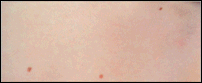
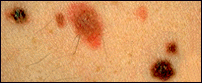
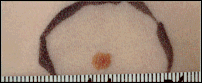
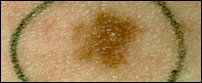
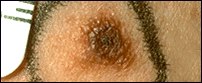
About one out of every ten people has at least one unusual (or atypical) mole that looks different from an ordinary mole. The medical term for these unusual moles is dysplastic nevi. The Pictures of Ordinary Moles and Dysplastic Nevi section shows the differences between ordinary moles and dysplastic nevi.
Doctors believe that dysplastic nevi are more likely than ordinary moles to develop into a
type of skin cancer called melanoma. Because of this, moles should be checked regularly by
a doctor or nurse specialist, especially if they look unusual; grow larger; or change in
color, outline, or in any other way.
Melanoma
Melanoma is a type of skin cancer--one of the most serious types because advanced melanomas have the ability to spread to other parts of the body. (Melanoma can also develop in the eye, called intraocular melanoma, or rarely in other parts of the body where pigment cells are found. The CIS can provide information about the diagnosis and treatment of intraocular melanoma.) Melanoma begins when melanocytes (pigment cells) gradually become more abnormal and keep dividing without control, moving into nearby normal tissue. The abnormal cells form a growth of malignant tissue (a cancerous tumor) on the surface of the skin. Melanoma can begin either in an existing mole or as a new growth on the skin. The Pictures of Melanoma section shows examples of melanoma. A doctor or nurse specialist can tell whether an abnormal-looking mole should be closely watched or should be removed and checked for melanoma cells. The purpose of routine skin exams is to identify and follow such moles.
The removal of a mole to look for cancer cells is called a biopsy. If possible, it is best to remove moles by an excisional biopsy, rather than a shave biopsy.
If the biopsy results in a diagnosis of melanoma, the patient and the doctor should work together to make treatment decisions. In many cases, melanoma can be cured by minimal surgery if the tumor is discovered when it is thin (before it has grown downward from the skin surface) and before the cancer cells have begun to spread to other places in the body. However, if melanoma is not found early, the cancer cells can spread through the bloodstream and lymphatic system to form tumors in other parts of the body. Melanoma is much harder to control when it has spread. The spread of cancer is called metastasis.
Doctors and scientists believe that it is possible to prevent many melanomas and to detect most others early, when the disease is more likely to be cured with minimal surgery. In the past several decades, an increasing percentage of melanomas have been diagnosed at very early stages when they are quite thin. Learning about prevention and early detection, while important for everyone, is especially important for people who have an increased risk for melanoma. Some of those at an increased risk are people who have dysplastic nevi or a very large number of ordinary moles.
Risk Factors for Melanoma
|
The National Cancer Institute booklet What You Need To Know About™ Melanoma has more information about risk factors for this disease.
It is important to remember that not everyone who has dysplastic nevi or other risk factors
for melanoma gets the disease. In fact, most do not. Also, about half the people who
develop melanoma do not have dysplastic nevi, and they may not have any other known risk factor
for the disease. At this time, no one can explain why one person gets melanoma while
another does not, but sun exposure, especially bad, blistering sunburns, is an important, avoidable
risk factor. Scientists are continuing their studies of risk factors for this disease.
Prevention of Melanoma
The number of people in the world who develop melanoma is increasing each year. In the United States, the number has more than doubled in the past 20 years.
Ultraviolet (UV) radiation from the sun and from sunlamps and tanning booths damages the skin and can lead to melanoma and other types of skin cancer. (Two types of ultraviolet radiation--UVA and UVB--are explained in the Glossary section.) Experts believe that much of the worldwide increase in melanoma is related to an increase in the amount of time people spend in the sun. Everyone, especially those who have dysplastic nevi or other risk factors, should try to reduce the risk of developing melanoma by protecting the skin from UV radiation. The intensity of UV radiation from the sun is greatest in the summer, particularly during midday hours (between 10 a.m. and 2 p.m. standard time, or 11 a.m. and 3 p.m. daylight saving time). A simple rule is to avoid the sun or protect your skin whenever your shadow is shorter than you are.
People who work or play in the sun should wear protective clothing, such as a hat and long sleeves. Also, a lotion that contains a sunscreen can help protect the skin. Some lotions protect the skin against both UVA and UVB radiation.
Sunscreens are rated in strength according to an SPF (sun protection factor). Sunscreens with an SPF of 15 or higher provide the best protection by blocking out most of the sun's harmful rays. It is important to use a sunscreen that blocks both UVA and UVB rays.
Sunglasses that have UV-absorbing lenses should also be worn. The label should specify
that the lenses block at least 99 percent of UVA and UVB radiation.
Early Detection of Melanoma
Because melanoma usually begins on the surface of the skin, it often can be detected at an early stage with a total skin examination by a trained health care worker. Checking the skin regularly for any signs of the disease increases the chance of finding melanoma early. A monthly skin self-exam is very important for people who have any of the known risk factors, but doing skin self-exams routinely is a good idea for everyone.
Here is how to do a skin self-exam:
- After a shower or bath, stand in front of a full-length mirror in a well-lighted room. Use a
hand-held mirror to look at hard-to-see areas.
- Begin with the face and scalp and go downward, checking the head, neck, shoulders, back,
chest, and so on. Be sure to check the front, back, and sides of the arms and legs. Also, check
the groin, the palms, the fingernails, the soles of the feet, the toenails, and the area between the toes.
- Be sure to check the hard-to-see areas of the body, such as the scalp and neck. A friend
or relative may be able to help inspect these areas. A comb or a blow dryer can help move hair
so you can see better.
- Be aware of where your moles are and how they look. By checking your skin regularly, you
will become familiar with what your moles look like. Look for any signs of
change in a mole, particularly a new black area or a change in outline, shape, size, color, or feel of a mole.
Also, note any new, unusual, or "ugly-looking" moles. If your doctor has taken photos of your
skin, you can compare these pictures with the way your skin looks on self-examination.
- Check moles carefully during times of hormone changes, such as adolescence, pregnancy,
and menopause. As hormone levels vary, moles may change.
- It may be helpful to record the dates of your skin exams and to write notes about the way your skin looks. If you find anything unusual, see your doctor right away. Remember, the earlier a melanoma is found, the better the chance for a cure.
In addition to doing routine skin self-exams, people should have their skin checked regularly by a doctor or nurse specialist. The family doctor can do a skin exam during visits for regular checkups. People who think they have dysplastic nevi should point them out to the doctor. It is also important to tell the doctor about any new, changing, or "ugly-looking" moles.
Sometimes it is necessary to see a specialist. A dermatologist (skin doctor) is likely to have the most training in diseases of the skin. Some plastic surgeons, general surgeons, oncologists, internists, and family doctors also have a special interest and training in moles and melanoma.
Doctors have found that melanoma runs in some families and that some members of these families are at high risk for the disease. In some of these families, certain members also have a large number of dysplastic nevi, often more than 100. These people have an especially high risk of developing melanoma. When two or more family members develop melanoma, it is important for all of the patients' close relatives (parents, brothers, sisters, and children above the age of 10) to see a doctor and be examined carefully for dysplastic nevi or any signs of melanoma. The doctor will then decide how often each person needs to be seen. (Doctors often recommend that these family members have checkups every 6 months.) Anyone who has a large number of dysplastic nevi also should be examined regularly.
A doctor may want to watch a slightly abnormal mole closely to see whether it changes over time. Pictures taken at one visit may be compared with the appearance of the mole at the next visit. Sometimes a doctor decides that a mole should be removed so that the tissue can be examined under a microscope. This surgery, called a biopsy, is usually done in the doctor's office using local anesthesia. It generally takes only a few minutes. The patient may require stitches, and a small scar will remain after healing. A pathologist examines the tissue under a microscope to see whether the melanocytes are normal, dysplastic, or cancerous.
Because most moles, including most dysplastic nevi, do not develop into melanoma,
removing all of them is not necessary. A doctor can recommend when and when not to remove moles.
Usually, only moles that look like melanoma, those that change, or those that are both new
and look abnormal need to be removed.
Other Booklets
The National Cancer Institute booklets listed below and others are available from the Cancer Information Service by calling 1-800-4-CANCER.
- What You Need To Know About™ Cancer
- What You Need To Know About™ Melanoma
- What You Need To Know About™ Skin Cancer
Pictures of Ordinary Moles and Dysplastic Nevi
|
Ordinary Moles |
Dysplastic Nevi | |
| Color | Evenly tan or brown; all typical moles on one person tend to look similar. | Mixture of tan, brown, and red/pink. A person's moles often look quite different from one another. |
 |
 | |
| Shape | Round or oval, with a distinct edge that separates the mole from the rest of the skin. | Have irregular, sometimes notched edges. May fade into the skin around it. The flat portion of the mole may be level with the skin. |
 |
 | |
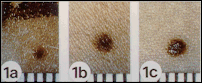
| Surface | Begin as flat, smooth spots on skin (1a); may become raised (1b) and form a smooth bump (1c). | May have a smooth, slightly scaly, or rough, irregular, "pebbly" appearance. |
 |
 | |
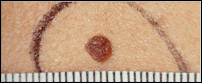
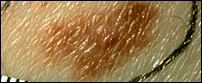
| Size | Usually less than 5 millimeters (about 1/4 inch) across (size of a pencil eraser). | Often larger than 5 millimeters (about 1/4 inch) across and sometimes larger than 10 millimeters (about 1/2 inch). |
 |
 | |
| Number | Between 10 and 40 typical moles may be present on an adult's body. | May be present in large numbers (more than 100 on the same person). However, some people have only a few dysplastic nevi. |
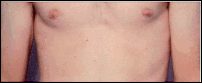 |
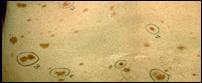 | |
| Location | Usually found above the waist on sun-exposed surfaces of the body. Scalp, breasts, and buttocks rarely have normal moles. | May occur anywhere on the body but most frequently on the back and areas exposed to the sun. May also appear below the waist and on the scalp, breasts, and buttocks. |
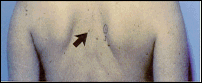 |
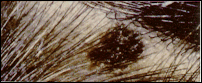 |
Pictures of Melanoma
| Large size |
Most melanomas are at least 5 millimeters
(about 1/4 inch) across when they are found; many
are much larger. An unusually large mole may be melanoma.
|
| Many colors |
A mixture of tan, brown, white, pink, red, gray, blue, and especially
black in a mole suggests melanoma.
|
| Irregular border |
If a mole has an edge that is irregular or notched, it may be melanoma.
|
| Abnormal surface |
If a mole is scaly, flaky, oozing, or bleeding, has an open sore that does not heal, or has a
hard lump in it, it may be melanoma.
|
| Unusual sensation |
If a mole itches or is painful or tender, melanoma may be present.
|
| Abnormal skin around mole |
If color from the mole spreads into the skin around it or if this skin becomes red or loses
its color (becomes white or gray), melanoma may be present.
|
 |
 |
 |
 |
 |
 |
National Cancer Institute Information Resources
You may want more information for yourself, your family, and your doctor. The following National Cancer Institute (NCI) services are available to help you.
![[Picture of Telephone]](htimages/phone.gif) Telephone...
Telephone...
Cancer Information Service (CIS)
Provides accurate, up-to-date information on cancer to patients and their families, health
professionals, and the general public. Information specialists translate the latest scientific
information into understandable language and respond in English, Spanish, or on TTY
equipment.
- Toll-free: 1-800-4-CANCER (1-800-422-6237)
- TTY: 1-800-332-8615
![[Picture of Personal Computer]](htimages/internet.gif) Internet... Internet... |
These web sites may be useful: |
| http://www.nci.nih.gov | NCI's primary web site; contains information about the Institute and its programs. Also includes news, upcoming events, educational materials, and publications for patients, the public, and the mass media on http://rex.nci.nih.gov. | |
| http://cancernet.nci.nih.gov | CancerNet™; contains material for health professionals, patients, and the public, including information from PDQ® about cancer treatment, screening, prevention, supportive care, and clinical trials, and CANCERLIT®, a bibliographic database. | |
| http://cancertrials.nci.nih.gov | cancerTrials™; NCI's comprehensive clinical trials information center for patients, health professionals, and the public. Includes information on understanding trials, deciding whether to participate in trials, finding specific trials, plus research news and other resources. |
![[Picture of Envelopes]](htimages/email.gif) E-mail...
E-mail...
CancerMail™
Includes NCI information about cancer treatment, screening, prevention, and supportive care. To
obtain a contents list, send e-mail to cancermail@icicc.nci.nih.gov with the word "help" in the
body of the message.
![[Picture of FAX Machine]](htimages/fax.gif) Fax...
Fax...
CancerFax®
Includes NCI information about cancer treatment, screening, prevention, and supportive care. To
obtain a contents list, dial 301-402-5874 from a fax machine hand set and follow the recorded
instructions.
Glossary
Anesthesia (an-es-THEE-zha): Loss of feeling or awareness. A local anesthetic causes loss of feeling in a part of the body. A general anesthetic puts the person to sleep.
Biopsy (BY-ahp-see): The removal of a sample of tissue, which is then examined under a microscope to check for cancer cells.
Cancer: A term for diseases in which abnormal cells divide without control. Cancer cells can invade nearby tissues and can spread through the bloodstream and lymphatic system to other parts of the body.
Dermatologist (der-ma-TAH-lo-jist): A doctor who specializes in the diagnosis and treatment of skin problems.
Dysplastic nevi (dis-PLAS-tik NEE-vye): Atypical moles; moles whose appearance is different from that of common moles. Dysplastic nevi are generally larger than ordinary moles and have irregular and indistinct borders. Often their color is not uniform, and ranges from pink to dark brown; they usually are flat, but parts may be raised above the skin surface.
Excisional biopsy (EX-sih-zhon-al BY-ahp-see): The surgical procedure of removing tissue by cutting it out and then examining the tissue under a microscope to check for cancer cells.
Lymphatic system (lim-FAT-ik): The tissues and organs that produce, store, and carry white blood cells that fight infection and disease. This system includes the bone marrow, spleen, thymus, and lymph nodes and a network of thin tubes that carry lymph and white blood cells. These tubes branch, like blood vessels, into all the tissues of the body.
Malignant (ma-LIG-nant): Cancerous; can invade and destroy nearby tissue and spread to other parts of the body.
Melanocytes (mel-AN-o-sites): Cells in the skin that produce and contain the pigment called melanin.
Melanoma: Cancer that arises in melanocytes, the cells that produce pigment. Melanoma usually begins in a mole.
Metastasis (meh-TAS-ta-sis): The spread of cancer from one part of the body to another. Cells in the metastatic (secondary) tumor are the same as those in the original (primary) tumor.
Mole: A benign growth on the skin (usually tan, brown, or flesh-colored) that contains a cluster of melanocytes and surrounding supportive tissue.
Nevus (NEE-vus): The medical term for a benign growth on the skin, such as a mole. A mole is a cluster of melanocytes and surrounding supportive tissue that usually appears as a tan, brown, or flesh-colored spot on the skin. The plural of nevus is nevi (NEE-vye).
Oncologist (on-KOL-o-jist): A doctor who specializes in treating cancer. Some oncologists specialize in a particular type of cancer treatment. For example, a radiation oncologist specializes in treating cancer with radiation.
Pathologist (pa-THOL-o-jist): A doctor who identifies diseases by studying cells and tissues under a microscope.
Pigment: A substance that gives color to tissue. Pigments are responsible for the color of skin, eyes, and hair.
Risk factor: Something that increases the chance of developing a disease.
Shave biopsy (BY-ahp-see): The procedure used to cut off thin layers of tissue, which are then checked under a microscope for cancer cells.
SPF (Sun protection factor): A scale for rating sunscreens. Sunscreens with an SPF of 15 or higher provide the best protection from the sun's harmful rays.
Sunscreen: A substance that helps to block the effect of the sun's harmful rays. Using lotions or creams that contain sunscreens can help protect the skin from premature skin aging and damage that may lead to skin cancer.
Tumor (TOO-mer): An abnormal mass of tissue that results from excessive cell division. Tumors perform no useful body function. They may either be benign (not cancerous) or malignant (cancerous).
Ultraviolet (UV) radiation (ul-tra-VYE-o-let ray-dee-AY-shun): Invisible rays that are part of the energy that comes from the sun. UV radiation can burn the skin and cause melanoma and other types of skin cancer. UV radiation that reaches the earth's surface is made up of two types of rays, called UVA and UVB rays. UVB rays are more likely than UVA rays to cause sunburn, but UVA rays pass deeper into the skin. Scientists have long thought that UVB radiation can cause melanoma and other types of skin cancer. They now think that UVA radiation also may add to skin damage that can lead to skin cancer and cause premature skin aging. For this reason, skin specialists recommend that people use sunscreens that block or absorb both kinds of UV radiation.
![[Back Arrow]](htimages/back_button.gif)
|
What You Need to Know About™ Cancer Publications Menu |
![[Home Button]](htimages/home.gif)